Project governance
Why Tamper-Evident Project Records Matter
Tamper evident project records preserve what was agreed, changed and accepted, helping bespoke teams assess evidence, accountability and payment readiness.
A site instruction can take less than a minute:
“Move that detail 50mm and make it work.”
Weeks later, after manufacture, delivery and installation, the question is no longer whether somebody said it. The question is what exactly was agreed, who had authority to agree it, what changed, what evidence supports the outcome, and whether the commercial consequences were understood and accepted.
That is where tamper-evident project records matter.
They turn a chain of informal exchanges, drawings, photographs, approvals and changes into a decision history that can be reviewed without relying on memory, goodwill or a search through old WhatsApp messages.
For high-value bespoke work, the issue is rarely a lack of communication. Teams communicate constantly. The commercial risk is that important communication is scattered, incomplete or capable of being quietly altered after the event.
A drawing is replaced in a folder. A message is deleted. A photograph loses its context. A site instruction is remembered differently by the person paying and the person carrying out the work.
A disciplined project record does not make difficult projects simple. It does make the important facts easier to establish before an invoice is delayed, a relationship deteriorates or a dispute begins.
What tamper-evident project records actually mean
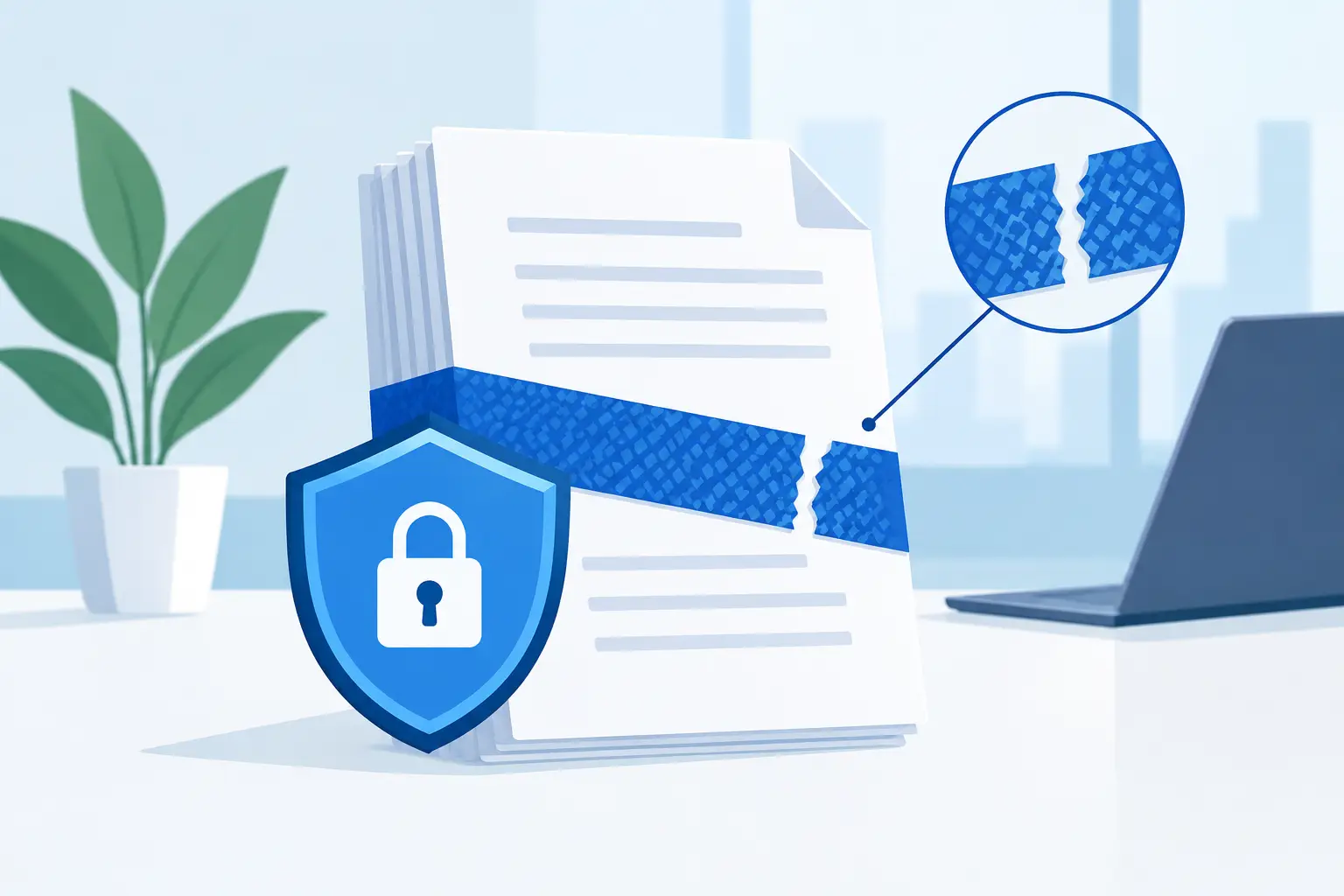
Tamper-evident does not mean that a project record can never change. Projects need corrections, revisions and updated information.
The important principle is that material history should not be silently rewritten.
- If an acceptance criterion changes, the record should show what it was before, what changed, who made the change, when it happened and why.
- If an evidence submission is replaced, the earlier submission should remain part of the history.
- If a milestone is challenged and later accepted, both decisions should remain traceable.
In stronger governance systems, this may be supported by append-only event histories, cryptographic hashes and signed exports that make later alteration detectable. That is different from simply keeping the latest version of a file.
A shared folder may show the latest drawing but not necessarily the drawing relied upon when fabrication started. A project-management platform may track tasks very effectively while a commercially important instruction remains buried inside an email thread or messaging group. Neither problem is solved by asking people to be more careful after the work has already progressed.
For bespoke joinery, fit-out, specialist fabrication and similar project work, the record needs to connect several things that are often separated: scope, milestones, acceptance criteria, changes, evidence, challenges, authorised decisions and payment readiness.
The purpose is not to create legal theatre or burden teams with unnecessary administration. It is to make material project decisions attributable, reviewable and capable of being checked later.
The commercial cost of an unclear history
Consider a reception desk manufactured to an approved drawing. During a site walk, a client representative asks for a revised cable route and an altered shadow gap. The workshop responds quickly because the programme is tight. The change requires redesign, additional material and another visit to site.
If the instruction, its consequences and the authority behind it are not captured, everyone becomes exposed. The contractor may struggle to demonstrate why the additional work was necessary. The client may reasonably ask why the cost was not presented for approval before it was incurred. The project manager may be left reconstructing a conversation they were not part of.
The same pattern appears at completion. “Sent you the photos on WhatsApp mate” is not a reliable acceptance process for a complex installed item.
Photographs can be useful evidence, but they are stronger when tied to a defined milestone, the relevant acceptance criteria, the location, the date, the person submitting them and the decision being requested. Otherwise, completed work can become disconnected from sign-off and payment readiness.
Unclear history also creates reputational damage. A specialist business that cannot readily demonstrate what changed may look disorganised even when its workmanship is excellent. Equally, a client who cannot clearly see what they are being asked to accept may feel pressured into approving work without enough information.
Good governance protects legitimate interests on both sides.
A practical record follows the work
The strongest approach is not to create one large archive at the end of a project. Material decisions should be governed as they happen.
A practical sequence is: define the milestone → establish acceptance criteria → submit evidence → make an authorised decision → establish payment readiness. Each part should connect to the next.
Set milestones around meaningful decisions
A milestone should represent a real project or commercial decision point, not simply a date in a programme. Examples might include:
- design release for manufacture;
- material or sample approval;
- fabrication completion;
- delivery to site;
- first-fix completion;
- installation completion;
- testing or commissioning;
- snag completion;
- practical completion;
- final handover.
Each milestone should have clear acceptance criteria. “High quality finish” is too vague to govern effectively. The criteria should instead identify what matters: the relevant drawing revision, material, approved finish sample, tolerances where appropriate, installation requirements and the evidence expected.
Not every project requires a lengthy specification. But the people carrying out the work and the people making the decision should be able to recognise what successful completion means.
Submit evidence with context
Evidence can include photographs, marked-up drawings, delivery notes, certificates, inspection records, sample approvals and confirmation of remedial work. The value is not only in the file itself. The value is in the context surrounding it.
A photograph of installed panelling becomes more useful when it identifies:
- the area or location;
- the relevant milestone;
- when the photograph was taken;
- who submitted it;
- which acceptance criterion it supports.
Evidence must also be proportionate to the decision. A close-up photograph may demonstrate finish quality but say nothing about concealed fixings. A delivery note may establish that an item reached site but not that it was installed correctly.
A modest variation may require a recorded instruction and revised price. A substantial design change may require updated drawings, programme impact, revised evidence requirements and explicit approval before work proceeds. The evidence should match the risk and nature of the milestone.
Approve or challenge in a defined place
Acceptance should be a clear decision. It should not be inferred from silence, a thumbs-up reaction or an unrelated conversation in a group chat. The authorised party should be able to accept the submission, challenge it or request further evidence.
Challenges are not necessarily a failure of the process. They can be evidence that the process is working correctly. If a finish does not match the approved sample, if evidence is incomplete or if another trade has prevented proper completion, the issue should be visible, attributable and capable of resolution.
A good record preserves both the original submission and the decisions that followed, creating a traceable decision history rather than a rewritten final state.
Authority matters here. Not everyone participating in a project has authority to approve a variation, accept completion or make a commercially binding decision. Recording who made the decision, for which party and under what authority helps prevent a familiar later argument:
“They had no authority to agree that.”
Establish payment readiness, not payment pressure
Payment readiness is not the same as a payment guarantee. It means authorised parties can see whether the agreed conditions for a commercial decision have been met: what was delivered, what evidence supports it, what remains challenged, what has been accepted and what still requires action.
That clarity helps a contractor present a properly evidenced application. It helps a client or representative review it without searching through several disconnected systems. It can also reveal when a payment request is premature, evidence is incomplete or an unresolved change needs a decision first.
Bespea provides a governance layer alongside existing drawings, email, messaging and project-management tools. It does not hold client funds or release milestone payments. Its role is to preserve the decision history and make evidence, authority and project state easier to review.
Why append-only decision history matters
When people know that a material decision will remain visible with its timestamp, origin and supporting evidence, conversations tend to become more precise. The contractor is more likely to record the cost and programme consequences of an instruction. The client is more likely to make a deliberate decision rather than assume somebody else has dealt with it. The project manager has a clearer basis for coordinating the next action.
That does not eliminate disagreement. Sometimes scope genuinely is uncertain. Site conditions can be unforeseen. Design information may arrive late. Another trade may prevent completion. A decision may simply not yet have been made.
In those situations, the record should preserve the uncertainty rather than manufacture certainty. It may show that work is paused pending instruction, that a proposal is under review, that additional evidence has been requested or that a decision remains outstanding. An honest unresolved state is generally more useful than a false record of certainty.
There are also limits to what a tamper-evident system can do.
- It cannot make poor evidence persuasive.
- It cannot create authority that never existed.
- It cannot decide who is legally right.
- It cannot turn an informal instruction into an agreed contractual variation merely because it was recorded.
What it can do is preserve the basis on which people acted. That may be exactly what a client, contractor, insurer, adviser or project director needs when an issue is reviewed later.
From project communication to project governance
The deeper value comes from connecting the records together. A project should not have one system for the contract, another for milestones, another for photographs, another for approvals and another for reconstructing the story after something goes wrong.
Bespea is designed around a different principle: preserve the contract, evidence, changes and authorised decisions as one traceable governance record rather than separate fragments across email, messaging and project-management systems.
The goal is not to replace every existing tool. Drawings may still live in a document system. Teams may still communicate through email or messaging. Project-management software may continue to manage programme and tasks. The governance layer answers a different set of questions:
- What was agreed?
- What changed?
- What evidence supported the decision?
- Who acted?
- For which party?
- Under what authority?
- What happened next?
- And can that history still be verified later?
Build the record before the relationship is tested
The best time to establish project governance is before the first disputed instruction, not after it.
- Decide which milestones require formal acceptance.
- Identify who may make material decisions.
- Define what evidence is proportionate.
- Agree how changes and challenges will be handled.
- Keep the process focused on decisions with commercial, programme or quality consequences.
Recording every minor exchange creates noise. Recording too little leaves the project exposed. A useful test is simple:
If this decision is questioned in three months, could both sides establish what was agreed, what changed, who decided it and what evidence supported the outcome?
If the answer depends on someone finding an old voice note or remembering a corridor conversation, the project needs a stronger record.
Protect the project while the work is still moving. A decision that can be reconstructed and verified later is often the difference between a difficult conversation and an avoidable dispute.