Project governance
How to Capture Client Approval Before Payment Delays
Learn how to capture client approval with clear milestones, evidence and governed decisions so bespoke work can progress towards payment readiness.
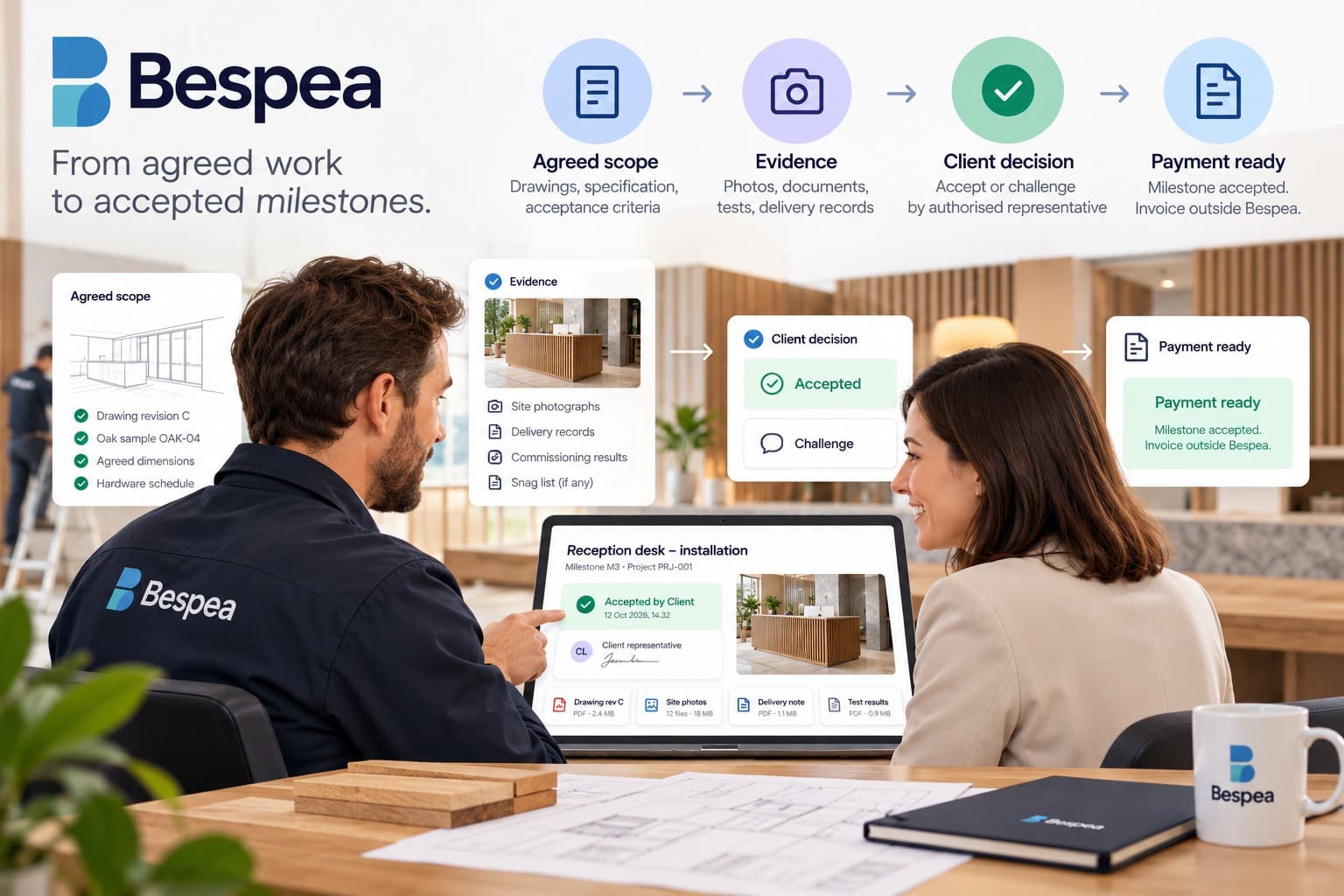
A completed installation can still be commercially stuck.
The joinery is fitted. The stone is in place. The client has seen the work. The site team may already have moved on.
Yet the invoice sits unanswered because nobody can show exactly what the client approved, against which criteria, what evidence was considered, and when the decision was made.
On bespoke projects, that gap matters.
Client approval should not be treated as a polite email reply, a verbal agreement on site or a thumbs-up in WhatsApp. Where the decision has commercial consequences, it should be treated as a governed project decision.
That means connecting the agreed scope, acceptance criteria, evidence of delivery, the approval request, the authorised person making the decision and the resulting acceptance or challenge in one coherent record.
The objective is not to force approval.
It is to make the decision clear and preserve what happened.
Why client approval becomes difficult
Most approval problems do not begin with bad intent.
They begin with ordinary project communication.
“Can we move that panel 50 millimetres?”
A project manager agrees verbally. The workshop acts. Manufacture continues.
Weeks later, the cost is challenged, the instruction is remembered differently, or someone argues that the revised arrangement was never formally approved.
The project team may have photographs, a drawing revision, emails, WhatsApp messages and a delivery note.
But scattered information is not the same as a decision record.
A photograph does not, by itself, establish what it was intended to prove.
A message does not necessarily establish that the person sending it had authority to accept the work.
And a drawing does not tell you whether the delivered work was actually reviewed against it.
The same problem appears at handover.
The client may be satisfied overall but unwilling to accept a milestone because one item remains outstanding. The contractor may consider it a minor snag. The client may consider it evidence that the milestone is incomplete.
Without agreed acceptance criteria and a recorded decision process, both positions can appear reasonable.
Approval therefore needs to be designed into the project rather than chased at the end.
Start with governed milestones
The project should be divided into meaningful decision points.
For specialist joinery or fit-out work, these might include:
- design release;
- material or finish approval;
- factory completion;
- installation completion;
- commissioning;
- snag close-out;
- final handover.
A milestone should describe something that can actually be assessed.
“Approve joinery” is too broad.
A stronger milestone might ask the client to accept that a completed reception desk matches drawing revision C, approved oak sample OAK-04, agreed dimensions and the specified hardware schedule.
That creates a defined basis for the decision.
Acceptance criteria should also be proportionate.
A simple item may require an approved drawing and delivery confirmation.
A high-value fabricated feature might require approved samples, inspection photographs, dimensional checks, commissioning records and an agreed snag schedule.
The goal is not to collect as much evidence as possible.
The goal is to preserve the evidence that matters to the decision.
Establish who has authority to decide
Knowing what is being approved is only half of the problem.
The project also needs to establish who is authorised to make the decision.
A client director, architect, project manager, designer and contract administrator may all participate in a project, but that does not mean they hold identical authority.
Access to project information is not the same as authority to make a governed decision.
A comment on site should not accidentally become contractual acceptance simply because it came from someone involved in the project.
Likewise, a valid decision should not become questionable months later because nobody can establish who made it or in what capacity.
For commercially significant decisions, authority should be established before the decision is required and preserved alongside the resulting record.
Define the approval request before asking for approval
A useful approval request should answer four questions:
- What is being decided?
- What requirements apply?
- What evidence supports the request?
- What does the resulting decision mean for the project?
For example, an installation-completion request might state that the work is ready for review against approved drawings, the finish schedule and agreed acceptance criteria.
The evidence could include dated photographs, delivery records, test results and an identified snag list.
The client is then reviewing a defined proposition rather than responding to a vague request to “sign this off”.
That distinction matters.
A governed approval process should reduce ambiguity before the decision is made rather than trying to reconstruct the meaning afterwards.
Evidence should support the decision
Project teams often have enormous quantities of evidence but very little structure around it.
Hundreds of photographs in a shared folder may demonstrate that work took place.
They may not demonstrate that a particular milestone met a particular acceptance criterion at a particular point in time.
Evidence becomes more useful when it is connected to its purpose.
A photograph can demonstrate a finished detail.
A marked-up drawing can identify an approved location.
A sample can establish an agreed finish.
A delivery note can establish when an item arrived.
A commissioning record can demonstrate that equipment was tested.
The evidence should therefore be connected to the milestone and decision it supports.
This becomes especially important when work will later be covered, removed for protection or incorporated into another assembly.
Once subsequent trades have progressed, reconstructing the original condition can become difficult.
Capture important evidence while the decision can still be properly reviewed.
Keep change control separate from acceptance
Approval becomes unreliable when the scope being assessed has changed without a clear record.
When a change occurs, record:
- what changed;
- what it changed from;
- why the change occurred;
- the relevant revision;
- likely effects on cost or programme;
- supporting evidence;
- who is authorised to decide it.
Sometimes work must proceed before every commercial consequence has been finalised.
That reality can also be recorded.
An instruction to protect the programme should not later be represented as though every cost consequence had already been agreed.
Separating change control from acceptance makes the eventual milestone decision clearer.
Instead of arguing:
“That isn’t what we agreed.”
The project can ask:
“Which revision applied, who authorised it, and what evidence supports that decision?”
Those questions can be answered from a governed project record.
Give the client a real choice: accept or challenge
Governance does not mean forcing acceptance.
The client needs a genuine opportunity to review the evidence and make a decision.
A milestone can be accepted when the agreed criteria have been met.
If the client believes they have not been met, the milestone can be challenged with reasons and supporting evidence where appropriate.
That challenge should not disappear into an email chain.
It should remain connected to the milestone, the evidence, the parties and the subsequent resolution.
Where remediation is required, the record should preserve what was challenged, what happened next and what was eventually resubmitted.
This creates a decision history rather than a collection of disconnected messages.
Preserve the decision, not just the document
A signed PDF can be useful.
But the more important record is the context around the decision.
What was the agreed scope?
Which revision applied?
What acceptance criteria were used?
What evidence was submitted?
Who made the decision?
Did that person have authority?
Was the milestone accepted or challenged?
Did anything change afterwards?
This is where Bespea’s governance model becomes different from ordinary document storage.
Bespea connects governed milestones, evidence submissions, authorised decisions and their history.
The Decision Passport preserves the sequence of governed decisions.
Proof Packs provide a portable, tamper-evident record that authorised parties can use to review what was agreed, what changed, what evidence was considered and what decisions were made.
Bespea does not decide who is right.
It does not provide legal advice.
It does not hold client funds.
It does not release money.
And it does not guarantee payment.
Its role is to preserve the governed project record so that commercially important history is harder to rewrite after relationships become difficult.
Connect acceptance to Payment Readiness
Acceptance and payment are related, but they are not the same thing.
Contract terms, valuations, retention, tax, purchase-order requirements, invoicing and internal client procedures may still apply.
Bespea therefore separates the governed project decision from the movement of money.
When the necessary project conditions are satisfied, the milestone can progress towards Payment Readiness.
That means the project record can show why the work is commercially ready to progress without Bespea pretending to be the payment processor.
Payment still happens outside Bespea.
This distinction matters.
The platform is not saying:
“Pay this invoice.”
It is preserving the evidence necessary to say:
“This is the governed project state, these are the decisions that produced it, and this is why the milestone is considered payment ready.”
A better record when payment questions arrive
When an invoice is questioned weeks later, the contractor should not need to reconstruct the entire project from WhatsApp, email, photographs and people’s memories.
The project should already be able to show:
Agreed scope → Acceptance criteria → Evidence → Authorised decision → Accept or Challenge → Payment Readiness
If the milestone was challenged, that history should remain visible too.
If it was resubmitted after remediation, the new decision should not erase the earlier one.
And if someone takes over the project midway through, they should be able to understand how the current position was reached.
That is useful not only to the contractor and client.
A project director, accountant, insurer, broker or authorised adviser may later need to understand the commercial history without reconstructing months of fragmented communication.
The objective is not more bureaucracy
Governance should be proportionate.
Not every site conversation needs to become a formal decision.
Not every photograph needs to enter a Proof Pack.
And ordinary coordination can continue in the tools teams already use.
The important distinction is consequence.
When a decision can materially affect scope, quality, programme, responsibility or payment readiness, it deserves a clearer record.
That is the purpose of governed approval.
The final question should no longer be:
“Who remembers what happened?”
It should be:
“What does the project record show?”
That is the record Bespea is designed to preserve.